By rights, Texas Bill should have been dead a long time ago. From 1846, when it entered the Union, until 1965, Iowa was a death penalty state. Except for a few years in the 1870s, when capital punishment was abolished, persons convicted of 1st degree murder would face the hangman’s noose. Bill was lucky, if you want to call it that. He had murdered Tom Swift in 1876, during repeal, so his punishment was life in prison.
And now, he was at the end of that life. It was New Year’s Day, 1903, and, while other convicts were celebrating the holiday, Texas Bill was nearing the end of the line. Double pneumonia was Dr. Druet’s diagnosis. Bill was in the prison hospital, burning up with fever, raving deliriously. During a moment of calm, and realizing that the end was near, he sent for his work foreman, Officer Cruise, as well as Texas Bill’s friend, a convict named Smith. To Smith, Bill bequeathed all his earthly possessions, which, from a financial standpoint, was a pittance. At the time, inmates were allowed to carve shell material in their cells into little trinkets, and sell their handiwork to prison visitors. Bill wanted to give his tools, and remaining bits of shell, to Inmate Smith.
Although he lingered a couple more days, William Dilley, aka “Texas Bill” breathed his last on January 3. News of his death quickly circulated around the prison. Although he was only a convict, he was much revered by staff and inmates alike. During his 26 years at Anamosa, he had compiled an exemplary record, was hard-working and industrious, and was a mentor and friend to many of the younger inmates. He was known as "Old Dilley” despite being only 51 when he died. He looked much older than his actual age, the product of years of heavy, manual toil and failing lungs, made worse by the dusty environment in the prison Stone Shed where he labored.
Dilley was one of the longest-serving inmates at Anamosa at the time of his death. His prison number, 239, attests to that. He was received in early 1877, when the prison consisted of a single building and a wood stockade fence. But by the time he departed his prison, and this earth, in 1903, the wall was completed, as well as the Administration Building, the Center Building, and a new cellhouse.
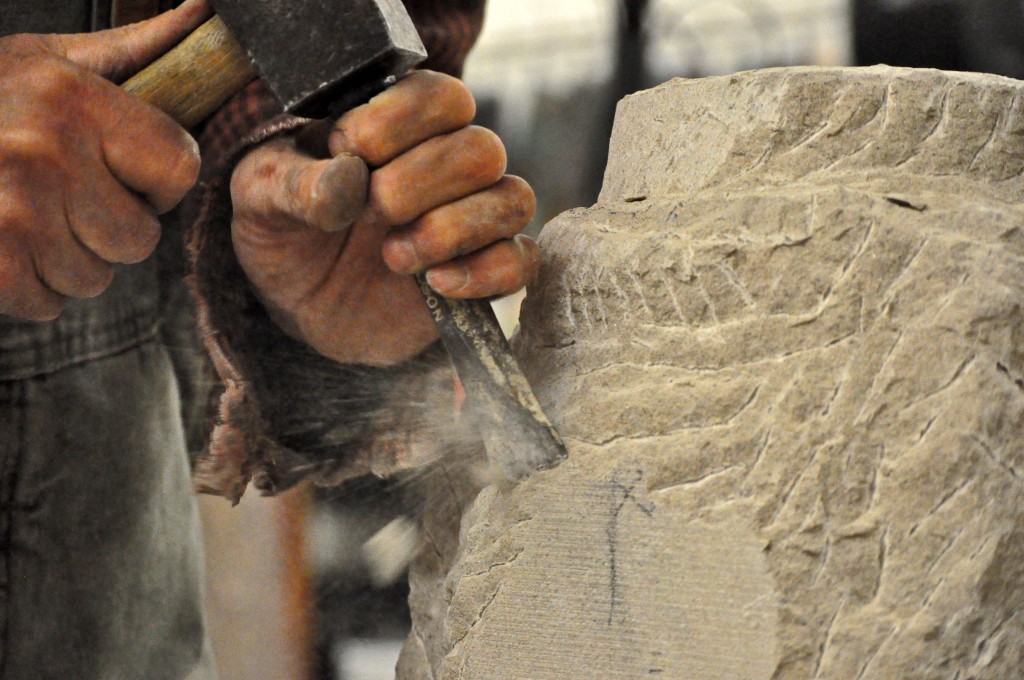
It would be hard to find another convict who gave more to the construction of the Anamosa prison than Texas Bill Dilley. You could easily argue that he gave his life for the cause, with over 20 years of breathing stone dust playing hell with his already weak lungs. Nonetheless, Dilley became a master stone craftsman during his time at Anamosa, personally touching and shaping thousands of the massive limestone blocks brought by rail car to the Stone Shed. And those he didn’t touch were still connected to him, really. For you see, he patiently trained and mentored many of the newer inmates assigned to the shed, teaching them all he knew.
So, in a way, almost every stone in this architectural masterpiece was his.
But Texas Bill wasn’t always so mature and responsible. Not by a long shot.
He was about 26 years old when he drifted into the little settlement of Morse Station, in Johnson County, north of Iowa City in the spring of 1876. He hired on with a railroad section gang under the supervision of Mr. Thomas Swift. Two months of Dilley’s drunkenness and disruptive influence with the other men was about all Swift could take, however, and he fired Texas Bill. Enraged, and convinced that Swift had shorted his final pay by seventy-five cents, Dilley swore revenge. The passage of several weeks did little to curb his rage, which he would fuel liberally with strong drink.
That Dilley premeditated Swift’s murder isn’t in dispute. He bought a pistol, got himself liquored up, and lay in wait for Swift. As Swift passed, Dilley fired a single shot, which caught Swift in the neck and left him in the dirt, completely paralyzed. He lingered awhile but there was no hope of recovery. Dilley, for his part, made no effort to flee, as if daring anyone to try to arrest him. “I’ll shoot anyone who tries!” he exclaimed. Several townsmen armed themselves and managed to disarm and hold Dilley until the Sheriff arrived to take him into custody.
The victim, Thomas Swift, was 32 years of age, had a wife and three children, and was dead over a 75 cent dispute.
The cowardly, dastardly nature of the murder stirred high feeling in Morse Station, and Iowa City, and there were serious concerns about Dilley getting lynched. With the death penalty no longer an option in Iowa, incidents of mob justice in cases like this were on the upswing. Sheriff Cavanagh, alarmed at the reports he was receiving, made elaborate arrangements to secrete Dilley out of the jail under cover of darkness, eventually landing him at the jail in Davenport. Judge Lynch would not be holding court in his county, if he had anything to say about it.
At his trial, Dilley’s lawyer put up a token defense, but the outcome was never much in doubt. There were eyewitnesses to just about everything. There was no escape from the ultimate verdict. Guilty of first degree murder. The penalty would be life in the Penitentiary at Anamosa, at hard labor. This new prison was but a few years old, built to take the pressure off the over-capacity Fort Madison Penitentiary. Anamosa had good rail service, one of the major considerations in locating the new prison there, and it was probably by rail, under heavy guard, that Dilley was transported to his new, and final, home.
What happened after the prison gates closed on Texas Bill? Where did that wild-eyed, drunken troublemaker go so quickly? They say he never received so much as a reprimand during his 26 years at Anamosa. Did the reality of how he had ruined his life, and the life of another, suddenly sink in and effect some dramatic transformation? Did the lack of liquor help settle an otherwise unsettled mind? Hard to know, but one thing is for certain. Texas Bill’s swagger was gone. Forever.
The years passed. Dilley found solace in work, carving the massive stones day in and day out. In fact, in the evening, he’d continue carving, creating stone mementoes resembling books, and shaping pieces of shell into little trifles that could be sold to visitors. Dilley would send the money to his brother, or to some shyster lawyer who would promise to help him get out. He would give some of his trinkets to the guard’s children who, at that time, amazingly, were allowed to come inside the prison and mingle with the inmates. Dilley was especially fond of Carrie Louise Gill, the little daughter of Major Edward J. Gill, a long-time guard and turnkey at the prison. Major Gill acquired his rank in the Civil War, prior to his service at Anamosa. He was well regarded among staff and convict alike. He and Dilley, over the years, gradually saw beyond their assigned roles with each other and became unlikely friends. Dilley would walk hand in hand with little Carrie across the yard. He was kind to her. In fact, after Carrie reached womanhood, married, and moved to Montana, she made annual visits back to Anamosa to see her parents and, of course, to talk with Old Dilley again.
In January 1905, the inmate editor of the prison newspaper wrote a story reflecting on his first days in the penitentiary, around 1894. He mentions both Dilley and Major Gill, and the piece is a rare window into the process of building this prison, which consumed so much time, manpower, and material for over sixty years of continuous construction. It is offered here, in its entirety:
“Along two sides of a long, low shed in the northeast corner of the yard, twenty-three men are engaged cutting stone for the buildings which the State needs to provide shelter and workshops for her wards.
Four men called 'bankers' slid the south door open and shoved a small flat car out to the derrick. They were 'taking away' a finished stone from a cutter and piling it with its kind in the stone-yard.
I looked into the shed. Down the center, the full length of the shed, is a track. The twenty-three cutters, six feet apart, were hewing stone.
Cutting stone is hard labor. I know by experience. Our sentences are particular to specify 'at hard labor.' You couldn't close your eyes and throw a stone at the Warden's fine residence without hitting a product of my two and one-half years of 'hard labor.' I laugh now as I think of the millions of sighs I paid for that grand pile of rock.
In those days the old shed stood on the site of the present ballground. It stood there for twenty-five years. When I entered it for the first time, eleven years ago, 'Old' Dilley was foreman. John Archibald was boss-in-chief of the works. The three guards have gone long since.
I had been waiting trial ten months, and felt as if I had been tasting that length of time. They happened to need a good man in the shed the day I arrived.
Four husky 'bankers' came with a car and deposited a huge stone of irregular shape on a pair of horses in front of what Old Dilley said was my bench. The bankers blocked up the stone to waist-height and then left me and Old Dilley to hew the rough stone into shape.
Sigh No. 1.
I was given an apron made of bedticking. The first thing Old Dilley told me was to make a 'bed' on the top side of the stone.
On a bench which projected just below the windows reposed my kit of tools: chisels of various shapes and sizes, a square, tooth-ax, bush-hammer, two straight edges, and a 2-foot rule.
My feet got cold while Old Dilley was telling me how to make a 'bed' on the top side of the stone. I looked at the big stove ten feet away. The guard looked at me. He appeared to be absorbing the heat enought for two, but his look was cold, I thought.
In the meantime Old Dilley had gone to attend to someone else. They kept him on the jump. "Make a bed," was all I had heard of his instructions, and that much was Greek to me.
I took up the smaller of the two mallets. It was heavy.
Sigh No. 2.
On both sides of me and across the track from me my fellow artisans were swinging their mallets as if a penny a minute were the regular wage. It was plain to me that they and I were working for the wages of sin.
I looked wistfully toward the big red-hot stove. My feet were cold, and my teeth were chattering. The guard looked coldly at me.
Old Dilley came to see how I was getting along with my 'bed'-making. The irregular mass on the horses was unscratched.
"How long have you to stay?" I asked Old Dilley, as he proceeded to show me how to cut a 'draft'.
His hair was gray. Age and care were depicted plainly in his face. He appeared to miss my 'fresh fish' inquisitiveness. I wanted to hear him say "a year or two", so I could tell him my tale of woe. Old Dilley did not answer. He handed me the mallet and chisel and went away.
Before night I learned that Old Dilley was a 'lifer'. He had twenty years of it already in. That was why the prisoners called him "Old' Dilley. That was why he looked so aged and careworn.
About the time (1876) the Younger brothers went into harbor in Stillwater, Old Dilley anchored in Anamosa. When the silent, grizzled veteran of the shed was initiating me into stonecutting, I did not think that I should live until January, 1903, and write his obituary.
I was heartbroken. The thought of his being in twenty years already crushed the feeble hope I had.
Presently Old Dilley returned to show me how to cut a draft to the straight-edge. That was the beginning of the 'bed.' The mallet was heavy. The chisel was nearly as cold as my feet. I handled the tools awkwardly. Instead of cutting a flat draft, I slanted it toward the center of the stone. Every time I cut over the draft I would try the straight-edge on it. The same high places were just as high. The red chalk on the straight-edge pointed out the high places.
I laid the mallet on the stone and looked toward the stove. I could see no sense in freezing, so close to a hot stove.
"Raise your hand after this and get permission before you leave your place."
I stood by the stove and listened to the guard's admonition. I was too cold to talk coherently and too disheartened to care for consequences. The guard's coldness was intensified by my seeming indifference. He repeated his first words, and added, as I was about to go to my place, "Get warm this time, but don't leave your place again without permission."
Sigh No. 3.
I looked at that stone and sighed again. All my life I had roamed at will. Now I was to confine my wanderings to a circuit the dimensions of a stone. I wished the stone were in a mill-pond with me under it.
Old Dilley has twenty long, weary years already served. I am just beginning. He looks 60 at 43. I am 25. Twenty years hence I may look like Old Dilley. To end it now will save a lifetime of suffering. I'll wait until I get in my cell.
My meditations were not the reflections of a strong, brave man.
The erstwhile 'Marco' man was my left-hand neighbor. The guard told him to show me. John would step over occasionally and give me a lesson. He told me to take it easy -- "it won't be so bad in warm weather."
Toward evening my wrist was lame. My bones ached. My head ached. My feet were cold. I was in misery. Through my mind kept running with persistent iteration the judge's words: "Life at hard labor. Life at hard labor." Old Dilley interrupted my meditations by telling me I was doing fine. "You'll make a good stonecutter," he added by way of good measure. John had squared up my slanting drafts and jointed the tow ends of the stone. The only good cutting I had done was to mar and bruise my left thumb.
Evening came. The guard rapped with his club on the railing of his stand. The sound of mallets and hammers ceased. I sighed a sigh of relief, and wished that I should die before morning.
Around the stove we waited the order to 'fall in.' John told me I'd be sore for a day or two. I was -- for a month or two.
At the tap of the deputy's bell we formed in line and marched lockstep* to the dining-room for supper. At that time the dining-room was where the Dynamo-room now is. I ate no supper.
After I got in my cell I changed my mind about ending it all. Meditation is good for a man. It occurred to me that I was adding to my burdens by worrying.
The cheerful "good evening" that Major Gill and 'Tip' Patterson, bid me, together with the thinking which I did that first night sent me to work next morning in better spirits. I did not then think, however, that I should ever develop into a "good stonecutter." I was about as awkward an apprentice as one could imagine. Neverthless, in two and one-half years' time, I helped building the Administration Building, the Central Building, and the water-tower.”
Perhaps the pinnacle of Dilley’s craftsmanship was the intricate stone carving evident in the great circular window in the back of the current auditorium, then the chapel. It’s beauty is breathtaking.
In his last years, now grey and slow of step, too worn out for the Stone Shed, Dilley spent his days in a tiny room off the Carpenter Shop, cutting, shaping, and polishing the wooden handles for all the tools used around the institution. He worked alone, rarely having visitors, a marked contrast to the energy, motion, and noise of the Stone Shed.
Dilley passed away at half past seven in the morning of January 3, 1903. His family asked to claim the body but, for whatever reason, failed to do so, so it appeared that Texas Bill would take his final rest in the prison cemetery, just beyond the Buffalo west of the prison. But then, a remarkable thing happened. Major Edward Gill, in a last act of reverence and friendship, made a claim for Dilley’s body. He, and a few old-time inmates, bore the expense of Dilley’s burial in Riverside Cemetery, not Boot Hill. Prison-hardened convicts wept as the cover was closed over Dilley’s casket, and a small cortege left the prison to escort Dilley’s body to Riverside, where he would rest among ordinary folk, with a certain measure of dignity, respect, and final redemption.
A convict named Tommie, a master stonecutter, took up the task of carving Dilley’s stone, shaping it with great care to be a proper testament to his mentor and friend. Another act of love in the unlikeliest of places. The stone remains to this day, down the hill a bit from the grave of Grant Wood, Anamosa’s famous painter.
Seventy-five cents. One wonders how the trajectory of so many lives would have been different if it weren’t for that pittance, and the singular act of madness that flowed from it.


